Decoding gender bias in job adverts
Unconscious gender bias
How does unconscious gender bias influence the way we think?
Let’s start with a riddle.
A father and son have a car crash. The father dies at the scene and the son is rushed to hospital. When he gets there, the surgeon says, “I can’t operate on him, he’s my son!”
How is this possible?
The surgeon is the boy’s mother.
Inequality in the workplace is deeply connected to our subconscious societal biases. This classic riddle, for example, shines a light on our invisible associations between jobs and gender.
So what does unconscious gender bias mean for job ads?
Research has shown that when women read a job advert containing words associated with male stereotypes, they can feel like they don’t fit the description. This invisible barrier can stop women from applying.
We created the Totaljobs Gender Bias Decoder to reveal – and help remove – this hidden gender bias in job adverts. But can it also help us uncover the challenges of the UK job market?
Did you know?

Women in the UK...
Work in worse-paid sectors than men

Women in the UK...
Occupy less senior positions than men

Women in the UK...
Earn less than men for the same work
Job adverts analysis
We put 1 million job ads from Totaljobs through the Decoder to find out how biased they are.
Turns out, the majority of job adverts contain a mix of gender-coded words: 50% included some male-coded words and 54% included female-coded words.*
1 million job ads from Totaljobs
Comparing the number of male-coded and female-coded words in each ad gives us their overall gender bias. 1 in 4 ads had an overall male bias. This is a slight improvement since 2019, where 1 in 3 ads were male-biased, but is still bad news for gender equality as it can put women off applying for these jobs.
Job adverts: gender bias breakdown
Decoding the definitions

Male bias
More male-coded words
Strong male bias
3+ more male-coded words than female-coded words

Balanced
Equal number of female- and male-coded words
Female bias
More female-coded words
Strong female bias
3+ more female-coded words than male-coded words
But why does this matter? Research has shown that women are put off applying for jobs that contain male-coded language, whereas female-coded language doesn’t put men off. To achieve greater workplace equality, we have to focus on addressing male bias.
We analysed how bias shows up in job ads through biased words, across different sectors, disciplines, and levels of seniority.
Biased words
Think of a typical job ad. What kind of language do they use? The word ‘independent’ might jump to mind - in fact, the phrase ‘working independently’ is found in 13% of job ads. But words like this have unconscious associations with male stereotypes. The Gender Bias Decoder can analyse this kind of phrase and suggest alternatives.
The most frequent male-biased and female-biased word stems are shown below.*
Top 10 male-biased words
% of job ads with these terms
Top 10 female-biased words
% of job ads with these terms
Biased sectors
Sectors are the types of company that people work for. One of the reasons there is a gender pay gap is because women are typically overrepresented in less well-paid sectors, such as charities.
And this is reflected in the language seen in the job ads for these sectors. The most female-biased sectors are education, non-profit/charity and health/nursing. And the most male-biased are automotive, science and marketing/advertising/PR.
Top 10 male-biased sectors
% strong male bias job ads
Top 10 most female-biased sectors
% strong female bias job ads
Biased disciplines
Disciplines are the roles that people work in. For example, if you’re a developer for an online shop, your discipline is IT but your sector is retail.
Top 10 most male-biased disciplines
% strong male bias job ads
Top 10 most female-biased disciplines
% strong female bias job ads
Biased seniority levels
Job ads slightly skew towards men at higher levels of seniority: 36% of management level ads are male-biased compared to 31% female-biased. At entry-level, job ads are twice as likely to be female-biased than male-biased (28% vs 14%).
Seniority levels: gender bias breakdown
Closing the gender pay gap
Job adverts are the first connection between a candidate and an employer in a large majority of cases. But because they are also heavily affected by gender bias, they have a direct impact on gender equality.
Removing male-coded language is a first step to improving the recruitment of a more diverse workforce, and promoting jobs in a way that is more inclusive and reflective of society. By improving the hiring - and retention - of women in sectors where they are today under-represented, and in better paying positions, every recruiter will contribute to helping reduce the gender gap - and the gender pay gap - in the UK.
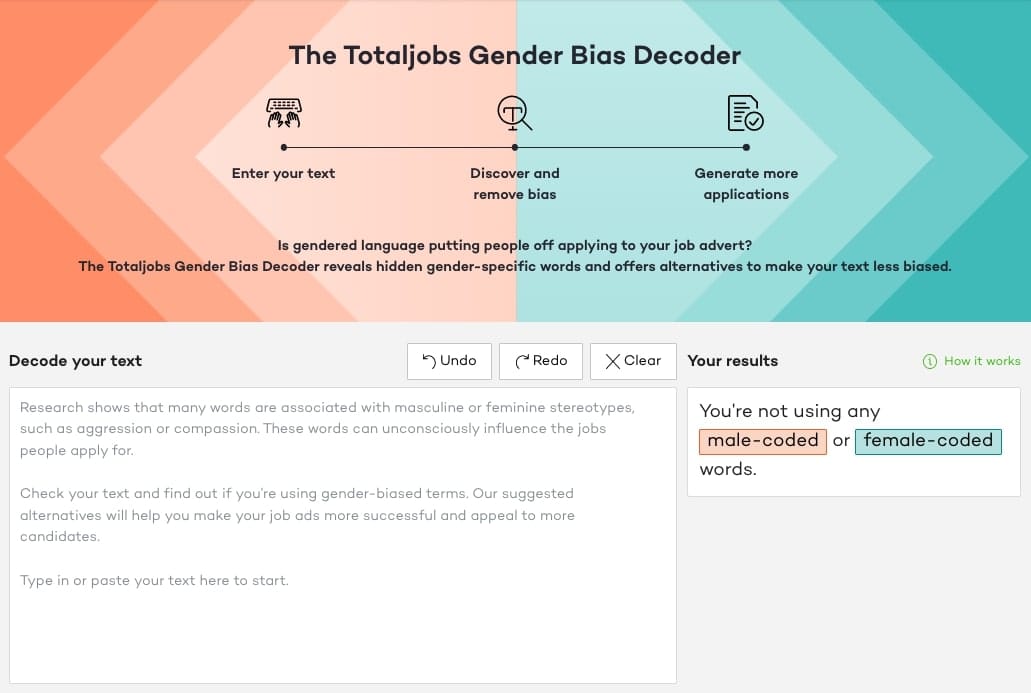
Check your job ads for gender bias
Are you putting people off applying to your job? Our Gender Bias Decoder uncovers hidden gender-specific phrases to remove, so you can generate more applications.
Source: 999,969 job ads live on Totaljobs from 1st December 2020 to 31st May 2021. Notes: Only industries/disciplines/seniority levels with at least 1,000 job ads were included in the analysis. The Gender Bias Decoder identifies multiple forms of each word, for example: independent, independently, independently. We have grouped all forms together under one term in this analysis. The Gender Bias Decoder only offers replacements when the terms appear in a particular context, such as ‘working independently’. *The terms responsible, supportive, lead and compete were removed from the analysis because they were pervasive across all disciplines and sectors, making the results less meaningful. They are still flagged by the Gender Bias Decoder.